Wednesday, April 16, 2014

Crab plover fight


The Crab Plover (Dromas ardeola) has a very heavy bill specialised for eating crabs and has partially webbed toes.

Here one of them had caught a crab and the others were trying to steal it, but they did not succeed in doing so as the bird with the catch ran away with the crab to a safe distance and decapitated the crab before eating it.

Canon 7D with 400mm f5.6L lens and 1.4X TC, 1/3200 @ f9, ISO 1600

Saturday, April 12, 2014

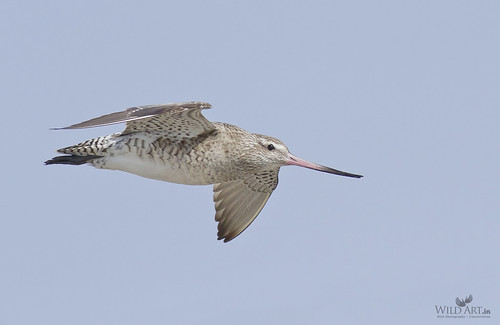
Bar tailed godwit in flight


Bar-tailed Godwit (Limosa lapponica) in flight

Bar-tailed Godwits (Limosa lapponica) have the longest known non-stop flight of any migrant, flying 11,000 km from Alaska to New Zealand. it is also the longest journey, to feed by any animal, without pausing.

Canon 7D with 400mm f5.6L lens and 1.4X TC , Av Mode, 1/3200 @ f9, 1600 ISO, EV +0.7

Tuesday, June 11, 2013

Crab Plovers - Living on the edge

The unique crab plovers are the only members of their family Dromadidae.
The huge oil tankers in the background represent the threats to the species (an oil spill waiting to happen)

Wednesday, June 5, 2013

Lesser Flamingos - Extreme feeding


Lesser Falmingos feeding, originally uploaded by wildlens.
We noticed that these Lesser Flamingos were feeding in an unusual manner, like dabbling ducks, maybe the high water level might have forced them to innovate a new way of extreme feeding.

Wednesday, May 29, 2013

Blue tailed bee-eater with prey

Blue tailed bee-eater with prey

It was an amazing sight watching these blue tailed bee-eaters catch insects in flight, to offer it to the females as part of their courtship.
photographing them was a challange, climbing on the sandy hillock nearby helped to get the eye level perspective.
Canon 7D with canon 400mmf5.6L lens ISO 800 aperture priority, 1/3200 @ f7.1

Monday, May 13, 2013

Desert fox vs Imperial Eagle


Had an amazing trip to Taal Chhappar (Nov'12), with Kunan, Mital and Arpit.
this was the highlight of the trip, in very low light we watched as this drama unfolded before our eyes as we were returning back.
This fox was also attacked by a harrier, It might have been out looking for harriers that might have settled down to roost.
Thanks to Kunan, Mital and Arpit for great company and Sharad Shridhar and Pooniaji for making our trip full of memorable experiances

Wednesday, September 12, 2012

Video: Cinnamon Bittern Calling

Experimenting with Video, had to learn a few new techniques to edit video, Posting our first video, of a Cinnamon Bittern Calling. click the HD Button to view in HD 720p

Cinnamon Bittern Calling from Wildlens on Vimeo.


Friday, July 15, 2011

The Oriental Darter or Indian Darter (Anhinga melanogaster)

Just as this darter was about to land, it dragged one of its wings on the surface of the lake startling a few fishes in the process, some of them jumped out of the water.

Thursday, July 14, 2011

Great white pelican


Great white pelican, originally uploaded by wildlens.

After watching this beautiful sight we came to know that the pelican is carrying a piece of a fishing net which it was able to break through. a few month ago other birds were not so lucky and here was proof that nothing was being done to stop illegal fishing.

Monday, July 4, 2011

Monsoon Magic !!!!


Was roaming on the terrace one day with the camera when the clouds rolled in, 
i shot this black kite just as it entered the area of backlit clouds,
underexposing a little to get the desired result.

Nikon D7000 with Sigma 50-500 DG on tripod. 
Aperture priority mode at f8, iso 1600 EV -0.3.

Monday, March 28, 2011

Take Pride?

Gone are the days when the sky would be filled with these beautiful scavengers circling gracefully.
watching them glide so effortlessly, we humans might have got the inspiration to create Gliders.
What are we talking about?
VULTURES of course.

A single drug "Diclofenac" has been linked to the conspicuous disappearance of many of the vulture species in India, along with the fact that they lay only one egg.
Most of them are either "Endangered" or "Critically Endangered" as per The IUCN Redlist.
They have served mankind by taking care of carrion so efficiently that we didnot even notice it.
What a Reward we have given them for their service.
(what happens to vultures also happens to us, when we take the drug for extended periods.)

Can't we Ban a single Drug from veterinary use, knowing that it has been "proven" deadly for all the vulture species?

Can't we stop Building a Rope-way in a place where pilgrims have walked on foot for time immemorial, and insist on doing so even now?

With all the money earned in the bargain will we be able to create another planet to escape to when Earth becomes Inhospitable to live in?

Even if we do will we be able to manage it any better than we are doing so right now?

Its time to realise that conservation of our Forests and wildlife is not only important for the future of the Vulture, Or the Tiger (pride of India) Or the Lion (pride of Gujarat),  but for the future of Humans on the planet.

If the policy makers and industrialists think that they can earn their billions and than spend it to secure the future for their Future Generations, That would be the stupidest (i.e. The most intelligent) Idea that man would ever have had.

Can we take pride in what we have done to the planet?
Its anybody's guess.

Friday, February 25, 2011

Wednesday, February 9, 2011

Camouflage in Nature

Most of the species including mammals,reptiles,birds,insects,etc.
have evolved to evade their predators by blending into their surroundings.
The color of Eggs and chicks also help them to blend into their surroundings
in order to win the race of survival in the wild.
Cryptic coloration is the most common form of camouflage.
At times colorful birds can also become invisible in the right environment.
Hope you like the following images showing some of the species that use camouflage
to evade their predators
Houbara Bustard (Chlamydotis undulata) camouflage
Sykes's Nightjar or the Sindh Nightjar (Caprimulgus mahrattensis)
Sandgrouse
Eagle Owl
MOTTLED WOOD OWL


Yellow-footed Green Pigeon (Treron phoenicoptera)
Eurasian Stone-curlew (Burhinus oedicnemus)

Friday, December 3, 2010

Did you know? Beak facts


Most waders have different lengths of beaks, so that even when they all feed together each species feeds at different depths. most waders have nostrils at the base of the beak and the tip of the beak is extra sensitive, to feel the prey underground.
The kiwi bird is unique in that it has nostrils at the tip of the beak, making it extremely sensitive to smell.

Monday, October 18, 2010

Published in BBC Wildlife magazine (oct '10)

Just got one of our images published in BBC Wildlife Magazine (oct '10) 
on page 111


Crows mobbing vultures (Gyps bengalensis)

Nikon D40 with Sigma 170-500mm DG Manual focus

Saturday, October 16, 2010

Sneak preview of Veolia Environnement Wildlife Photographer of the Year

The world’s most prestigious wildlife photography competition,
Veolia Environnement Wildlife Photographer of the Year, 
has revealed the commended images from this year’s competition. 
Have a Sneak preview

Search This Blog

Google search

Google search Results

ARKive blog

Photographic tips, equipment reviews and more.......

Photo Rumors

Flipkart.com

DIY-Photography


Thanks for Visiting our Blog